Book vs Movie: The Shining (1977, Stephen King) vs. The Shining (1980, Stanley Kubrick)
- Jodie
- 1 minute ago
- 8 min read

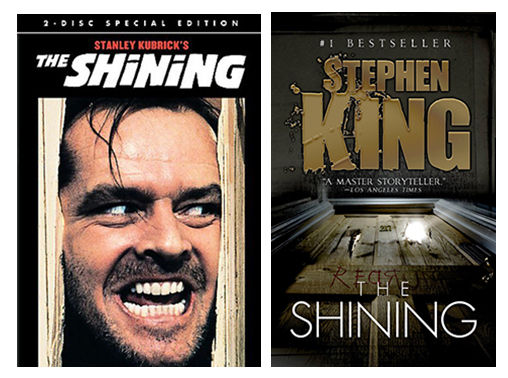
Stephen King’s The Shining (1977) is widely regarded as one of the defining novels of modern horror, combining supernatural terror with an emotionally charged exploration of addiction, domestic abuse, and the fragility of family relationships. Three years later, Stanley Kubrick adapted the novel into what has become one of the most celebrated horror films in cinema history. Although Kubrick’s adaptation follows the broad outline of King’s story of a family isolated in the haunted Overlook Hotel during a harsh Colorado winter, the film diverges significantly from its source material in its treatment of atmosphere, plot, characters, and themes. These differences have sparked decades of debate, with Stephen King himself famously criticising the adaptation for abandoning the emotional heart of his novel. Rather than serving as a straightforward adaptation, Kubrick’s The Shining functions as a reinterpretation of King’s work, transforming a story about addiction and redemption into one centred on psychological instability and inevitable madness. While both versions are masterpieces in their respective mediums, they succeed for very different reasons.
At its core, King’s novel is fundamentally a family drama disguised as a horror story. Although ghosts, psychic abilities, and supernatural forces play a significant role in the narrative, the true conflict revolves around the Torrance family’s attempt to heal after years of emotional damage. Jack Torrance accepts the position of winter caretaker at the isolated Overlook Hotel hoping to repair his marriage, reconnect with his son Danny, and overcome his battle with alcoholism while finishing his writing. Readers are introduced to a deeply flawed man who recognises the harm his addiction has caused, particularly after drunkenly breaking Danny’s arm years earlier. Throughout the novel, Jack struggles constantly against his temper, his guilt, and his fear of failure. The Overlook Hotel does not create these weaknesses but exploits them, gradually manipulating him until he loses control. This portrayal transforms Jack into one of Stephen King’s most tragic protagonists. His descent into madness is heartbreaking precisely because readers witness his genuine desire to become a better husband and father before supernatural forces overwhelm him.

Kubrick presents an entirely different interpretation of Jack Torrance. From his first appearance on screen, Jack Nicholson portrays him as unsettling and emotionally detached. His exaggerated facial expressions, forced smiles, and increasingly erratic behaviour create the impression that instability already exists within him before the family even arrives at the hotel. Rather than depicting a decent man slowly corrupted by evil, Kubrick suggests that Jack’s descent into violence is almost inevitable. Consequently, the emotional focus of the story changes dramatically. King’s readers mourn Jack’s gradual destruction because they understand what he is fighting to preserve, whereas Kubrick’s audience fears Jack almost immediately. Stephen King has repeatedly expressed dissatisfaction with this interpretation, arguing that Kubrick misunderstood the novel’s central message. According to King, Jack should remain sympathetic because his eventual corruption demonstrates the destructive power of addiction rather than simply revealing an inherently violent personality. Despite these criticisms, Nicholson’s performance has become one of the most iconic in horror cinema, largely because his unpredictable intensity creates an atmosphere of constant unease.

Perhaps the greatest difference between the novel and film lies in their respective atmospheres. King’s novel builds horror gradually through isolation, uncertainty, and psychological tension. Long before ghosts appear, the Overlook Hotel feels deeply unsettling. Strange noises echo through empty hallways; mysterious events occur without explanation, and Jack becomes increasingly obsessed with researching the hotel’s violent past. Through newspaper clippings, historical records, and conversations with former employees, King constructs an extensive mythology that suggests the building has absorbed decades of murder, corruption, and suffering. The horror emerges slowly, allowing readers’ imaginations to fill in the gaps. One of the novel’s most memorable examples is the hedge animals surrounding the hotel. Initially appearing as ordinary topiary sculptures, they gradually seem to move whenever characters look away before eventually attacking Hallorann during the climax. King never fully explains how they move, relying instead on suggestion and suspense to create fear. This subtle approach demonstrates the novel’s emphasis on psychological horror over overt spectacle.
Kubrick replaces King’s slow-burning supernatural dread with visual and psychological unease. His Overlook Hotel is characterised by enormous corridors, impossible architecture, symmetrical framing, and lengthy tracking shots that create a profound sense of disorientation. The hotel feels less like a traditionally haunted building and more like an endless labyrinth that traps both its inhabitants and the audience. Kubrick generates tension even in scenes where nothing overtly frightening occurs. Danny’s repeated journeys through the hotel on his tricycle, for example, become increasingly nerve-racking due to the changing sounds of the wheels moving between carpet and wooden flooring. Likewise, the appearance of the Grady twins has become one of cinema’s most recognisable horror images despite their limited dialogue. Kubrick’s atmosphere relies less on imagination than King’s and more on visual composition, sound design, and silence. As a result, the novel invites readers to fear what they cannot fully see, whereas the film unsettles viewers through imagery that has become permanently embedded within popular culture.
The differences between the two versions become even more pronounced when examining their plots. Although the overall narrative remains recognisable, Kubrick significantly alters several key events. Perhaps the most famous example is the replacement of King’s hedge animals with the hedge maze. In the novel, the moving topiary animals symbolise the hotel’s supernatural influence and create some of the story’s most frightening sequences. Kubrick removed them, believing that the special effects available in 1980 could not convincingly portray moving hedges on screen. Instead, he introduced the enormous hedge maze, which becomes central to the film’s climax. During the final confrontation, Danny escapes by walking backwards through the snow to hide his footprints, allowing Jack to lose his trail before eventually freezing to death. This ending is entirely absent from the novel and demonstrates Kubrick’s preference for visual suspense over supernatural confrontation. While many readers prefer the eerie unpredictability of the hedge animals, numerous critics argue that the maze provides one of cinema’s most memorable and suspenseful finales.

Another significant alteration involves the hotel’s boiler. In King’s novel, Jack is repeatedly reminded to release pressure from the faulty boiler to prevent it from exploding. As he falls under the hotel’s influence, he neglects this responsibility. Eventually, the boiler explodes, destroying the Overlook entirely. This event serves as an obvious metaphor for Jack himself, whose years of suppressed anger, addiction, and resentment finally erupt with catastrophic consequences. Kubrick removes this subplot altogether. Instead, the hotel survives intact while Jack freezes to death in the hedge maze. The film concludes with the now-famous photograph showing Jack standing among guests at the Overlook’s 1921 Independence Ball, suggesting that he has somehow become permanently absorbed into the hotel’s history. Whereas King’s ending offers emotional closure by destroying the source of evil and allowing Danny to escape, Kubrick’s conclusion embraces ambiguity, leaving audiences questioning the nature of time, identity, and the hotel’s supernatural power.

Dick Hallorann’s role further illustrates the contrasting philosophies of the novel and film. In King’s version, Hallorann responds to Danny’s psychic call for help and undertakes a dangerous journey through the snow to rescue the family. Although Jack seriously injures him, Hallorann survives and later becomes an important father figure for Danny following the destruction of the Overlook. His survival represents hope and reinforces the novel’s belief that goodness can ultimately overcome evil. Kubrick dramatically alters this sequence by having Jack kill Hallorann almost immediately after he arrives at the hotel. After spending much of the film travelling across the country to rescue Danny, Hallorann is struck down with an axe moments after entering the building. Many viewers have criticised this change because it appears to undermine the purpose of his journey. Nevertheless, the scene reinforces Kubrick’s bleak worldview by demonstrating that heroism does not necessarily guarantee survival.

The characterisation of Wendy Torrance differs almost as dramatically as Jack’s. King’s Wendy is intelligent, resourceful, and emotionally resilient. Although frightened by Jack’s deterioration, she repeatedly protects Danny and actively resists the hotel’s influence. During the climax she displays remarkable courage while fighting for her family’s survival. Kubrick’s Wendy, portrayed by Shelley Duvall, is considerably more anxious and emotionally vulnerable. She spends much of the film reacting to Jack’s increasingly erratic behaviour rather than confronting him directly. Stephen King strongly criticised this portrayal, arguing that Kubrick reduced Wendy from a capable and determined woman into a perpetually terrified victim. However, modern critics have often defended Duvall’s performance, suggesting that her vulnerability accurately reflects the psychological exhaustion of someone enduring prolonged domestic abuse. While King’s Wendy arguably possesses greater agency, Kubrick’s interpretation provides a raw and emotionally convincing portrayal of fear.

Danny Torrance remains one of the strongest characters in both versions, although his portrayal differs in subtle but important ways. In the novel, readers gain direct access to Danny’s thoughts, fears, and psychic experiences. His relationship with his imaginary friend Tony is explored in significant depth, allowing readers to understand both the burden and isolation created by his extraordinary abilities. Kubrick externalises these experiences through striking visual imagery, including the infamous elevator filled with blood, Danny’s disturbing visions of the Grady twins, and flashes of violence scattered throughout the hotel. While these sequences have become some of horror cinema’s most iconic images, they inevitably sacrifice some of the emotional intimacy and psychological complexity found in King’s novel.
These contrasting approaches reflect the fundamentally different themes explored by each work. King’s novel is primarily concerned with addiction, domestic violence, redemption, forgiveness, and the enduring strength of family. The Overlook functions as both a literal haunted hotel and a metaphor for addiction itself, exploiting Jack’s weaknesses while feeding upon his self-destructive impulses. Ultimately, however, King offers hope. Jack briefly regains control before his death, urging Danny to flee and sacrificing himself to destroy the hotel. This moment suggests that love and humanity can survive even the most overwhelming darkness.
Kubrick’s film, by contrast, largely abandons the theme of redemption in favour of psychological horror and existential ambiguity. His adaptation explores madness, isolation, fate, cyclical violence, and the terrifying possibility that evil cannot truly be escaped. Jack never meaningfully regains his humanity, and the final photograph implies that he has always belonged to the Overlook in some inexplicable way. Rather than providing emotional closure, Kubrick leaves audiences with lingering questions about identity, time, and supernatural destiny. This ambiguity has become one of the defining features of the film, inspiring decades of interpretation and analysis.
Ultimately, determining which version is superior depends largely on the qualities one values most. King’s novel excels in character development, emotional depth, and thematic complexity. Jack’s gradual descent is profoundly tragic because readers understand both his flaws and his sincere desire to overcome them. Wendy emerges as a stronger and more capable protagonist, Danny’s psychic abilities receive richer exploration, and the Overlook itself possesses a far more detailed history that transforms it into a fully realised antagonist. Conversely, Kubrick’s adaptation surpasses the novel in terms of visual storytelling, atmosphere, and cinematic tension. His meticulous direction, haunting cinematography, unforgettable imagery, and masterful use of silence create an experience unlike any other horror film. Scenes such as Danny cycling through the corridors, the Grady twins standing motionless in the hallway, the elevator overflowing with blood, Jack’s “Here’s Johnny!” sequence, and the mysterious final photograph have become enduring symbols of horror cinema.
Although Stephen King has often described Kubrick’s adaptation as an excellent film but a poor adaptation, both versions deserve recognition as masterpieces. King’s The Shining remains one of the greatest horror novels ever written because of its compassionate exploration of addiction, family, and redemption. Kubrick’s film remains one of the greatest horror films because of its unparalleled atmosphere, psychological tension, and visual artistry. Rather than competing with one another, the novel and the film demonstrate how the same story can be transformed to explore entirely different dimensions of fear. Together, they continue to shape the horror genre, proving that while literature and cinema may tell the same story, they often reveal very different truths about human nature, trauma, and the darkness that lies beneath the surface.


Comments